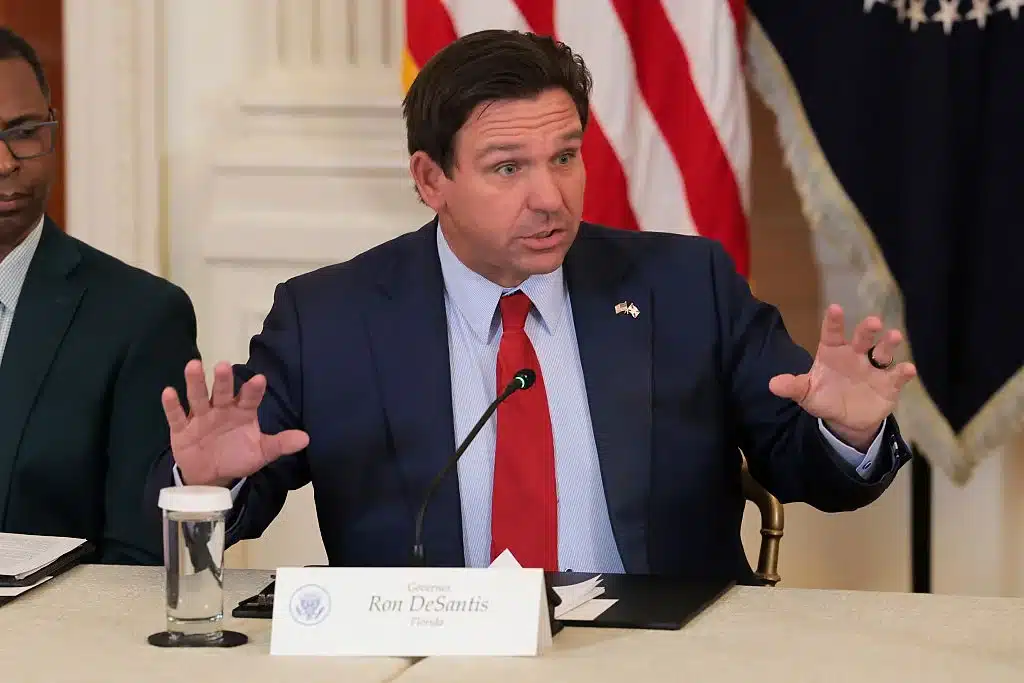
Attorney Mark Elias filed a federal lawsuit Wednesday challenging Florida’s newly enacted election law, HB 991, just hours after Governor Ron DeSantis (R) signed it, according to Mediaite. The complaint contends the legislation violates the First and Fourteenth Amendments by placing unconstitutional burdens on voters and threatening to disenfranchise eligible citizens.
Governor DeSantis has described the law as “Florida’s version of the SAVE Act,” a proposal championed by President Donald Trump. “The bill in question was HB 991, which makes multiple revisions to the Florida Election Code, including (from the final staff bill analysis) requiring voters to submit documents proving their citizenship status to register or remain on the voter rolls, requiring the Florida Department of Highway Safety and Motor Vehicles (DMV) to include a driver’s legal status on a driver’s license or identification card, requiring political candidates to disclose whether they have dual citizenship, prohibiting a person from qualifying as a candidate if they legally changed their name during the 365 days prior to qualification, and revising the list of acceptable identification for voting to remove student IDs and public assistance IDs.”
Elias announced early Wednesday that he would sue the state as DeSantis prepared to sign the measure. Describing HB 991 as “a new voter suppression law,” Elias said DeSantis “is every bit as unhinged as Trump,” and vowed legal action the moment the bill became law. Shortly after the signing ceremony, his firm followed through, filing a 54-page complaint in the U.S. District Court for the Northern District of Florida on behalf of the Florida State Conference of Branches and Youth Units of the NAACP and the Florida Alliance for Retired Americans.
The defendants named in the suit include Florida Secretary of State Cord Byrd and the Supervisors of Elections for all 67 counties. The complaint charges that HB 991 “purports to advance ‘election integrity’—this time, in the name of stopping the fictional threat of widespread noncitizen voting. But far from safeguarding Florida elections from unlawful voters, HB 991’s new requirements will exclude citizens from the electoral process, violating Florida voters’ First and Fourteenth Amendment rights and undermining the integrity of Florida elections in the process.”
Abha Khanna, a partner at Elias Law Group, called HB 991 “one of the worst voter suppression laws in modern American history,” arguing that the legislation could force more than one million Floridians, including long-time residents, to produce original citizenship documents or risk being dropped from the rolls. “The state’s own data shows that noncitizen voting is virtually nonexistent in Florida,” Khanna claimed, adding “if this law goes into effect, the number of eligible Florida citizens who will be disenfranchised will be far, far greater than the number of ineligible voters who will be prevented from casting a ballot.”
The Florida NAACP, one of the plaintiffs, emphasized the timing of its legal challenge. Spokesperson Pamela Burch Fort said the organization filed suit now to ensure “we have plenty of time to challenge this harmful voter suppression law before the 2028 elections.”
HB 991 is scheduled to take effect on January 1, 2027, after the 2026 midterm elections but ahead of the 2028 presidential race. The lawsuit seeks a judicial declaration that the proof-of-citizenship requirement “violates the Constitution, an injunction barring the defendants from enforcing those provisions of the law, and costs and attorneys’ fees under 42 U.S.C. § 1988.”