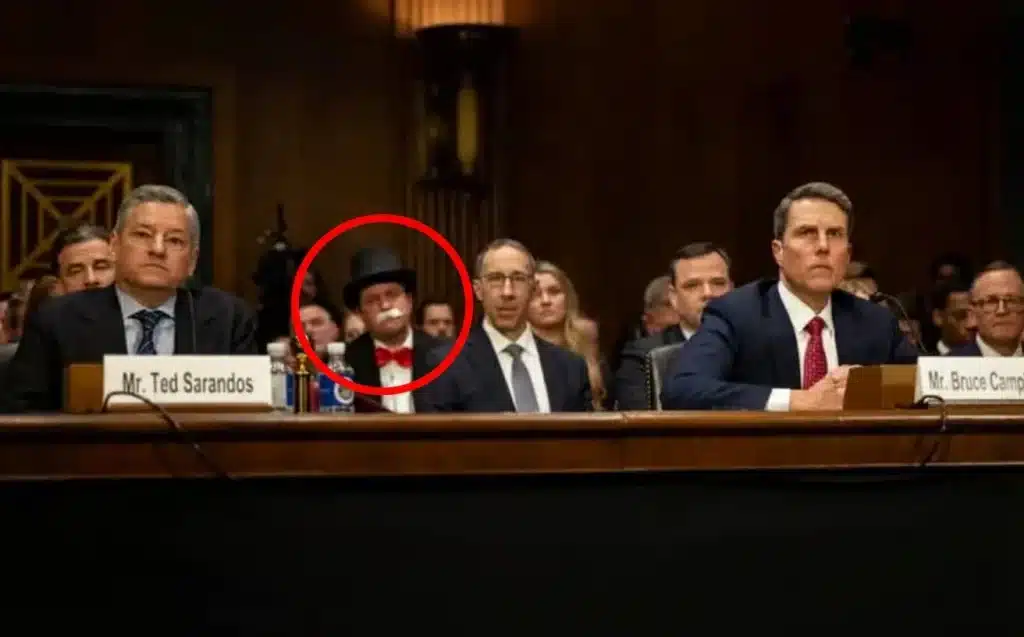
A Senate Judiciary subcommittee hearing on Tuesday took an unexpected turn when a familiar pop-culture figure appeared just behind two major media executives. Netflix Co-CEO Ted Sarandos and Warner Brothers Discovery Chief Revenue and Strategy Officer Bruce Campbell were testifying before lawmakers as Netflix seeks approval for its proposed $83 billion acquisition.
While the session was formally focused on the implications of the massive merger, Republican senators repeatedly shifted the discussion toward what they described as “overwhelmingly woke” programming on streaming platforms.
At one point, the presence of a man dressed as Rich Uncle Pennybags — the mustache mascot from the board game Monopoly — drew attention from the legislators. Senator Ted Cruz paused the hearing to reference the costumed attendee, saying, “The gentleman sitting behind you in the Monopoly outfit. Um, in your view, are monopolies a good thing in America?” Sarandos responded directly, “No, sir, they’re not.”
The Monopoly Man also caught the eye of Republican Senator Mike Lee, prompting further attention to the silent figure seated behind the witnesses. Lee posted a photo on X and wrote:
Buzzfeed reports that the person in costume was later identified as Ian Madrigal, a longtime activist known for appearing in the background of congressional hearings. Madrigal, a trans and queer activist, who uses the they pronoun, has staged similar visual protests for years. In 2017, they gained notice while sitting behind Richard Smith, the former chairman and CEO of Equifax Inc., during testimony following the company’s data breach.
In a 2019 interview with The Washington Post, Ian spoke about all the protesting he has done over the years, saying, “Surprisingly, I’ve never been arrested for anything I’ve done. It’s like a white person superpower.”
Madrigal has continued to appear at high-profile events, including the 2023 antitrust lawsuit brought against Google. In July 2025, they took their Rich Uncle Pennybags persona to the streets during a Federal Trade Commission workshop addressing gender-affirming care for children, using the costume to protest the agency’s actions.
Buzzfeed notes that the game Monopoly has anti-capitalist roots, having been created in 1903 by progressive activist Elizabeth Magie. She originally called it The Landlord’s Game, intending it as a critique of wealth concentration. The modern version of the game was later popularized by Charles Darrow.