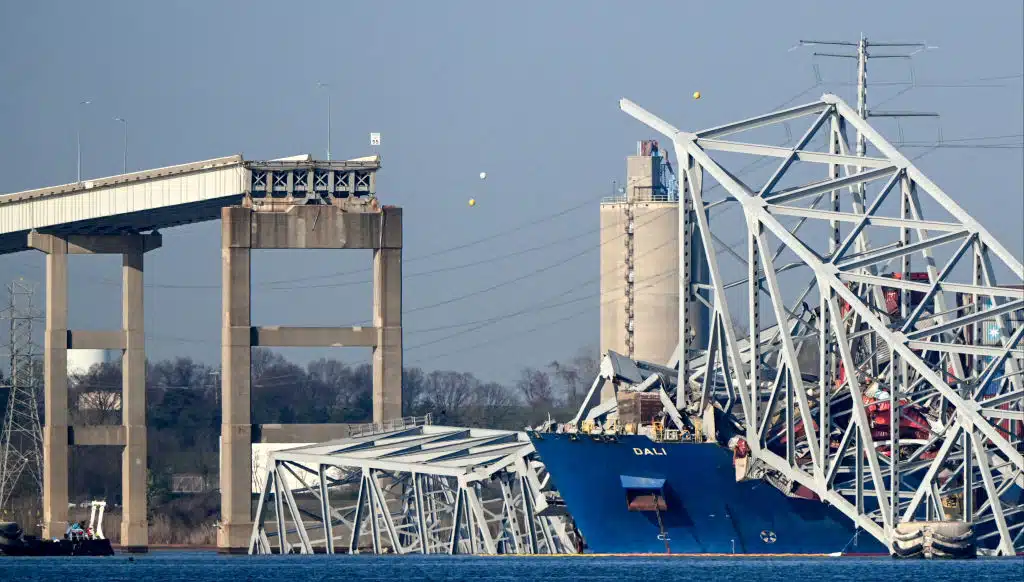
A single loose wire caused the catastrophic collapse of Baltimore’s Francis Scott Key Bridge, and the rebuilding effort could now cost Maryland up to $5.2 billion, significantly higher than initial projections, Fox News reports. The National Transportation Safety Board (NTSB) found that a misinstalled wire led to a complete power outage on the cargo ship Dali, leaving it powerless and unable to steer just before it collided with a bridge support on March 26, 2024. The crash caused the bridge to fall into the Patapsco River, resulting in one of Maryland’s deadliest infrastructure disasters.
The NTSB’s report revealed that the power failure was triggered by a loose signal wire due to improper installation, which caused a blackout at a critical moment. The crew attempted to restore power but could not recover quickly enough, making the collision with the bridge unavoidable. Furthermore, the Maryland Transportation Authority (MDTA) was criticized for not conducting a vulnerability assessment, a step experts say could have led to protective measures against such impacts.
Investigators also found that the Dali’s crew had improperly used a flushing pump as a service pump, a violation that hindered the vessel’s ability to restore power after the blackout and went unnoticed by the ship’s operator, Synergy Marine Group. Additionally, critical electrical systems were running in manual rather than automatic mode, complicating efforts to regain control after the power loss. Communication failures meant highway workers on the bridge had no time to escape before it collapsed.
The aftermath of the disaster continues to affect Maryland. State officials now say it will take until 2030 to rebuild the bridge, two years longer than previously estimated, and cost as much as $5.2 billion—far more than the $1.9 billion figure used to secure federal funding.
The NTSB report underscores a pileup of failures, from a single faulty wire to years of missed safety recommendations, that together created the conditions for tragedy. As Maryland works to rebuild, the state faces prolonged recovery, growing expenses, and renewed scrutiny on infrastructure safety.