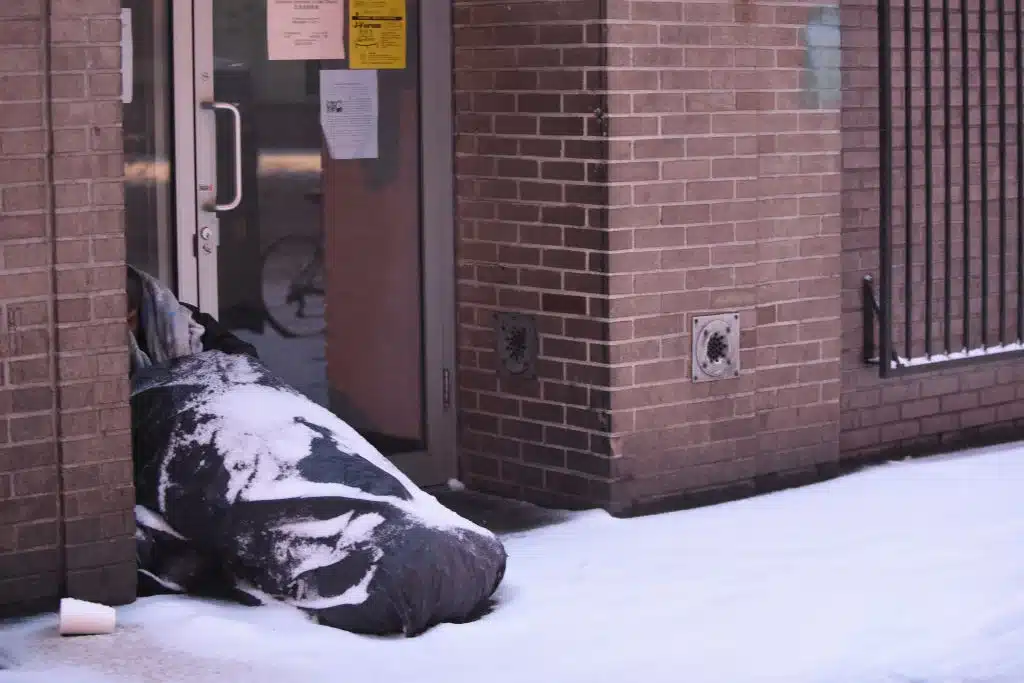
According to the mayor’s office, at least 13 homeless individuals have died on New York City streets amid a prolonged cold spell gripping much of the eastern United States. Responding to criticism, a spokesperson for the Mamdani administration said the city had arranged more than “800 placements” for homeless individuals, but acknowledged that many continue to refuse public services despite the life-threatening conditions.
“His new age will be one of relentless improvement,” New York City Mayor Zohran Mamdani declared last November as voters elected him to the city’s highest office. That promise, however, was not met when winter’s most brutal conditions set in.
The mayor suggested that the issue lies not solely in the fatalities themselves, but in how they are framed. “Too often, this is a crisis that is distilled only into statistics,” Mamdani said, adding that those who interact directly with homeless individuals often “learn of how they have been failed by the city for years.” He also expressed sympathy for people who refuse services “because of what their experience has been in the past.”
In practice, many of those living on the streets lack the capacity to make informed decisions about their own safety. Of the 13 deaths reported so far — a number expected to increase as agencies finalize their counts — most involved individuals with serious mental health or substance-abuse issues. Allowing such conditions to persist reflects a permissive approach that is both reckless and morally indefensible.
During his inaugural address, Mamdani delivered a speech: “For too long, those fluent in the good grammar of civility have deployed decorum to mask agendas of cruelty.” He went on to say New Yorkers would be “warmed against the January chill by the resurgent flame of hope,” and that through communalism, “we will replace the frigidity of rugged individualism with the warmth of collectivism.”
Asked why the city permits those who decline assistance to remain outdoors, Mamdani said officials rely on several indicators to assess risk. “I think we can find some of this criteria also in how an individual is clothed,” he said, “whether they are deemed to actually be warmed in those settings.” He added that a person’s “behavior” is another factor used to determine whether they can safely remain outside.
Mamdani emphasized that “involuntary confinement” is considered a “last resort,” though it is occasionally used. He said he was proud of city employees who “are continuing to canvas people again and again,” even when outreach efforts fail to persuade individuals to enter shelters.
As the New York Post writes, Mamdani has consistently declined to “break up homeless encampments,” criticizing the policy used by his predecessor as inhumane and inadequate compared with simply offering housing. Last year, he told the New York Times that the solution to homelessness required “strengthening rental assistance, increasing transitional and supportive housing, expanding respite residences, tripling city-produced affordable housing and fully funding eviction-prevention services.” Yet each proposal assumes the homeless population is willing to accept shelter — an assumption that does not always hold, even when lives are at stake.
Former Mayor Eric Adams, whom Mamdani replaced, took a different view. “There is nothing ‘progressive’ about leaving people to freeze in makeshift encampments,” Adams wrote last year in response to Mamdani’s pledge to keep encampments intact. “It harms residents and dehumanizes the very people who need help.”