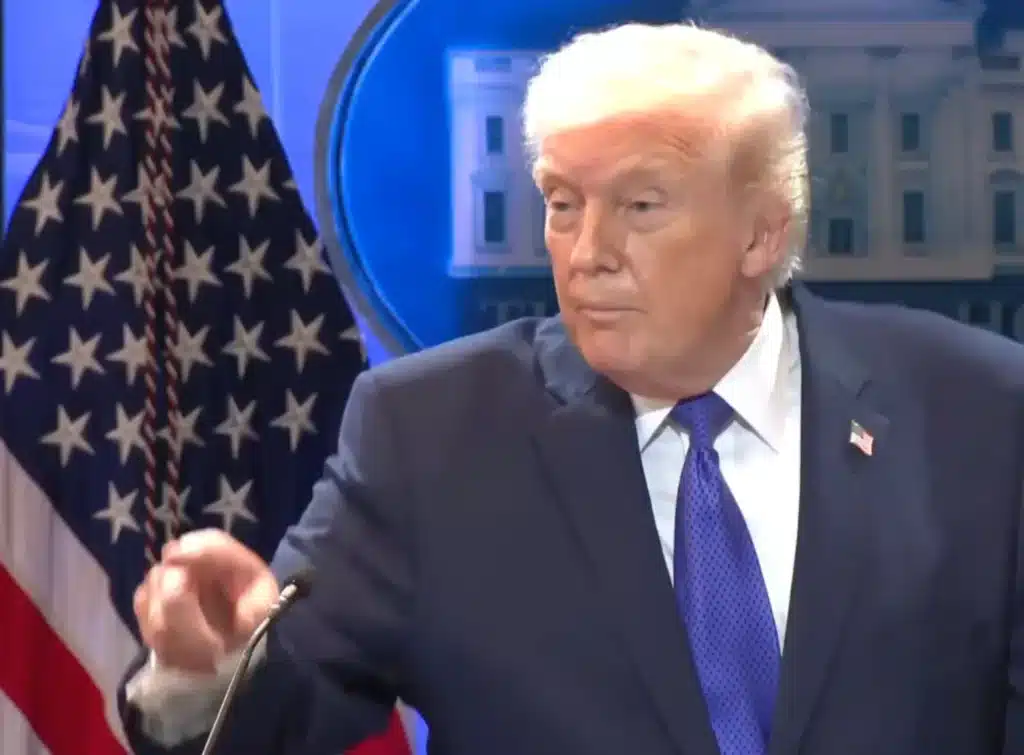
President Donald Trump said Tuesday evening that the United States will temporarily pause its maritime initiative known as Project Freedom, following requests from Pakistan and other nations. However, he made clear that the U.S. Navy’s blockade in the Strait of Hormuz will continue.
“Based on the request of Pakistan and other Countries, the tremendous Military Success that we have had during the Campaign against the Country of Iran and, additionally, the fact that Great Progress has been made toward a Complete and Final Agreement with Representatives of Iran, we have mutually agreed that, while the Blockade will remain in full force and effect, Project Freedom (The Movement of Ships through the Strait of Hormuz) will be paused for a short period of time to see whether or not the Agreement can be finalized and signed,” the president wrote in a post on Truth Social.
The decision to suspend the U.S.-led mission—which was launched earlier in the week to escort commercial vessels through the strategically vital waterway—comes amid escalating tensions. Iranian forces have recently launched drone and missile strikes targeting U.S. military positions in the region, prompting a response from American forces that resulted in the destruction of six Iranian small boats.
Earlier Tuesday, Defense Secretary Pete Hegseth described the current ceasefire between the U.S. and Iran as holding, though fragile. He reiterated that Project Freedom is a short-term defensive measure intended to restore the flow of shipping through the strait, which has been largely disrupted in recent weeks due to Iranian actions.
“This is separate and distinct from Operation Epic Fury,” Hegseth told reporters at the Pentagon. Later in the day, Secretary of State Marco Rubio confirmed to reporters at the White House that Operation Epic Fury has concluded.
Rubio also criticized Iran’s leadership, describing them as having “insane in the brain” leaders, and cautioned against provoking Trump as tensions persist in the region.
“This is not an offensive operation. This is a defensive operation. And what that means is very simple, there’s no shooting unless we’re shot at first,” Rubio told reporters.
Project Freedom has involved a significant U.S. military presence, including multiple Navy destroyers, as well as air and ground forces, supported by approximately 15,000 personnel under U.S. Central Command.
Hegseth noted that two American commercial vessels, accompanied by U.S. destroyers, successfully passed through the Strait of Hormuz earlier Tuesday.
“We know the Iranians are embarrassed by this fact,” Hegseth said during the press conference. “They said they control the strait — they do not. So, American ships led the way, commercial and military, shouldering the initial risk from the front — as Americans always do. Right now, hundreds more ships from nations around the world are lining up to transit.”
Gen. Dan Caine, chairman of the Joint Chiefs of Staff, added that as of Tuesday morning, more than 1,500 vessels carrying roughly 22,500 mariners remain stuck in the Persian Gulf.