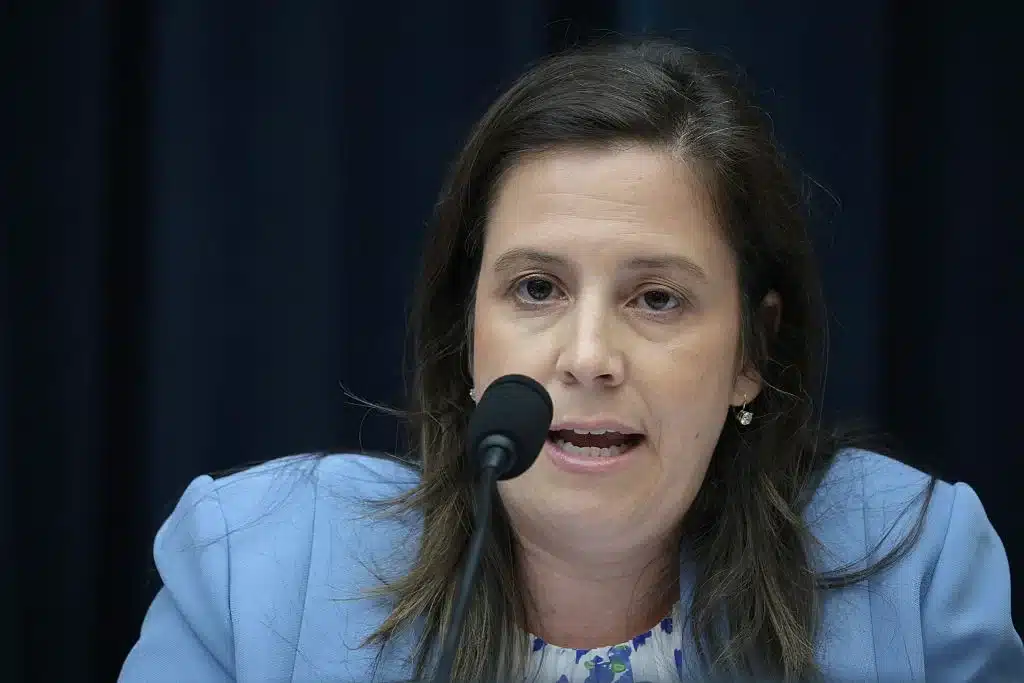
CNN anchor Jake Tapper pressed Rep. Elise Stefanik (R-NY) in a combative interview Sunday, but the congresswoman forcefully pushed back against what she framed as a misleading attempt to equate President Donald Trump’s tough rhetoric on Iran with calls for genocide.
According to Mediaite, the clash on State of the Union began as Tapper revisited Stefanik’s widely noted exchange with university presidents over antisemitism on campus. Stefanik, who drew praise from many in the Jewish community for her direct questioning, reaffirmed her position that calls for violence—such as the slogan “From the river to the sea”—should be clearly condemned.
“Yes, of course,” she said when asked if genocide should always be denounced, stressing that her line of questioning to university leaders was intentionally simple and rooted in principle. “And that’s why the question I asked, which was, does calling for the genocide of Jews violate your university’s code of conduct, yes or no? I worded it because it was a very simple straightforward question. It was not a political one,” she explained. “And the world heard as these universities equivocated saying it depends on the context or it’s a context-dependent decision. It is not.”
Tapper then pivoted to Trump, citing a Truth Social post warning that “a whole civilization will die,” and suggested it paralleled the rhetoric Stefanik had criticized on campuses.
Stefanik rejected that comparison outright, arguing Tapper was ignoring the clear context.“He was focusing on the Iranian regime,” Stefanik said. “And what did it do? It brought the Iranians to the table. It led to the ceasefire. We know that President Trump has very strong statements when it comes to his tweets, but it has been targeted towards the Iranian terrorist regime.”
Stefanik firmly informed Tapper that the remarks were aimed at a hostile regime, not civilians. She emphasized that strong rhetoric has long been part of geopolitical pressure tactics, particularly when dealing with adversarial governments.
As the exchange intensified, Stefanik turned the focus back to rising antisemitism, highlighting incidents involving Jewish students facing harassment, vandalism, and threats. She argued that such realities demand clear moral consistency—something she suggested was missing in Tapper’s framing.
“You’re equivocating, like those university presidents,” she told him.
Tapper denied applying a double standard, but continued to question whether Stefanik was doing just that. She dismissed the premise, reiterating that there was no contradiction in her position.
“But when it comes to a president threatening to wipe out an entire civilization…you’re applying two different standards here,” Tapper said.
“He is targeting the Iranian terrorist regime,” Stefanik responded. “Everyone seems to understand that Jake, except for CNN.”
Tapper responded, “I just think a call for genocide on a college campus and a call for genocide made by the President of the United States, like, they’re both bad, right?”
“I condemn genocide across the board,” Stefanik said, adding, “President Trump didn’t call for genocide, Jake. You are putting those words in his mouth.”
“Your entire civilization will die?” Tapper replied.
“It’s the terrorist regime, Jake,” Stefanik reiterated. “He’s targeting the terrorist regime.”
“I condemn genocide across the board,” Stefanik said. “President Trump didn’t call for genocide, Jake. You are putting those words in his mouth…Everyone seems to understand that, except for CNN.”
The exchange ended without resolution, but with Stefanik doubling down on her defense. “President Trump was not calling for genocide,” she said. “Shame on CNN for saying that.”