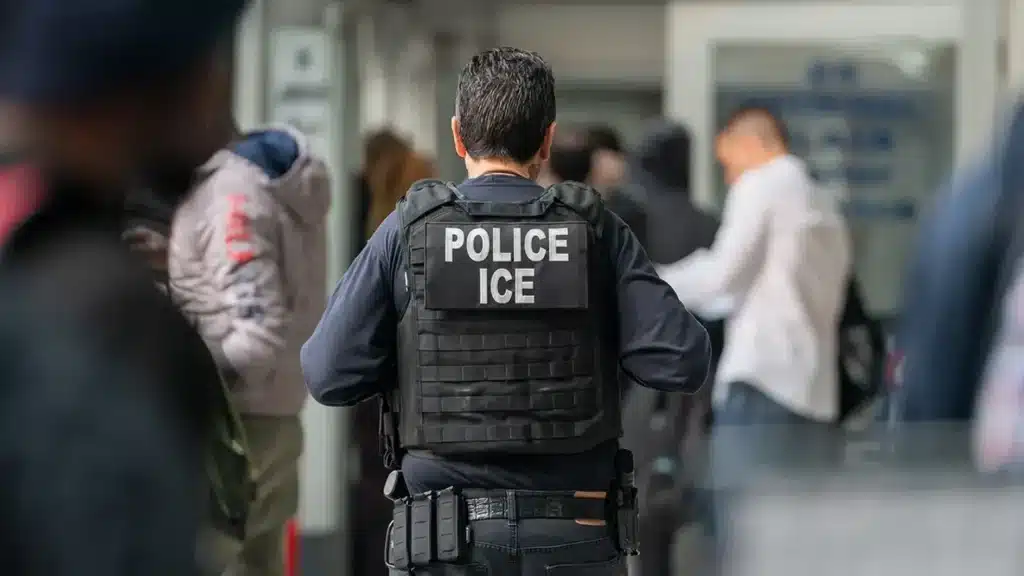
New York is moving closer to enacting what could become its most far-reaching sanctuary policies to date, as Governor Kathy Hochul and Democratic lawmakers in Albany finalize a deal that would sharply limit cooperation between local law enforcement and federal immigration authorities, the New York Post reports.
Assembly Speaker Carl Heastie said Wednesday that roughly “95%” of the anti-ICE package has been settled as part of ongoing state budget negotiations. The proposal would establish New York’s first statewide sanctuary law, setting firm rules on how police and other agencies interact with Immigration and Customs Enforcement.
While key elements are largely agreed upon, lawmakers are still ironing out important details about how the policy would operate in practice. Heastie framed the effort as a response to what he described as overly aggressive federal enforcement, while emphasizing the importance of maintaining due process protections.
“I think we all want to deal with the aggressiveness, or the over-aggressiveness, let’s say, of ICE. But we also understand that there should always be due process,” Heastie told reporters Wednesday, according to The Post.
Hochul recently signaled she was willing to go further than her initial January proposal, which was introduced amid heightened backlash to President Trump’s immigration crackdown. Last week, she underscored her position, saying ICE “has no reason to be involved in any civil enforcement.”
Her original plan included several key provisions: prohibiting local governments from entering “287-g” agreements that deputize local officers to carry out federal immigration duties, limiting ICE access to “sensitive” locations such as schools, hospitals, and houses of worship, and creating a new legal pathway allowing individuals to sue federal agents in state court for alleged constitutional violations.
Since then, state legislators have pushed to expand the scope of the proposal significantly. Additions under discussion include broader sanctuary protections that would largely bar local law enforcement from communicating with ICE, a major expansion of what qualifies as a “sensitive” location — potentially covering most public spaces like parks — and provisions allowing private businesses to deny entry to federal agents. Another controversial measure would prohibit ICE agents from wearing masks.
One notable shift appears to be the removal of a carveout that would have allowed police to contact ICE when there was probable cause of a crime. That exception has faced strong opposition from Albany Democrats, and Heastie indicated it is no longer part of the plan. “That definitely has been out,” Heastie said.
The proposal has drawn sharp criticism from law enforcement groups, particularly county sheriffs who argue they were excluded from the policymaking process. The New York State Sheriffs’ Association warned that restricting communication with federal authorities could undermine public safety well beyond immigration enforcement.
Opponents also argue the policy risks creating legal ambiguities and reversing post-9/11 efforts to improve coordination across different levels of law enforcement. They say limiting information-sharing could reintroduce the kind of fragmentation that agencies have worked for decades to overcome.
Hochul, however, has pushed back on those concerns, insisting that cooperation with federal agencies targeting serious criminal activity will continue. “We’ll work with DEA. We’ll work with FBI. We always have,” she said.