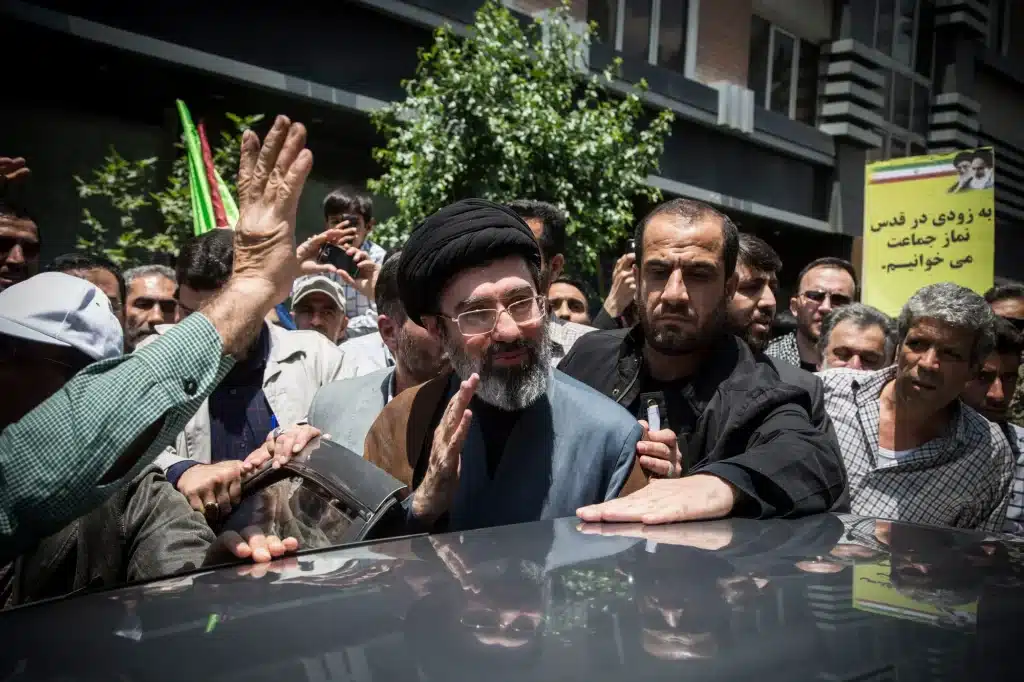
Leaked audio obtained by The Telegraph suggests Iran’s new supreme leader narrowly escaped death during a joint U.S. and Israeli strike that killed his father, Ali Khamenei, along with other senior leaders of the Islamic Republic.
According to the recording, Mojtaba Khamenei survived because he stepped outside into the garden just moments before missiles struck his residence.
The audio features remarks delivered by Mazaher Hosseini, head of protocol in Ali Khamenei’s office, during a briefing with senior clerics and commanders from the Islamic Revolutionary Guard Corps. His address reportedly offered the first detailed account of what occurred inside the supreme leader’s compound during the Feb. 28 attack.
According to Hosseini, Mojtaba Khamenei had briefly gone outside when the strike began. Israeli Blue Sparrow ballistic missiles struck the compound at approximately 9:32 a.m. local time, destroying several residences.
“God’s will was that Mojtaba had to go out to the yard to do something and then return,” Mr. Hosseini said. “He was outside and was heading upstairs when they struck the building with a missile. His wife, Ms. Haddad, was martyred instantly.”
Hosseini said Mojtaba Khamenei suffered only a minor leg injury in the attack. However, the blast killed his wife and son immediately and also killed his brother-in-law in a particularly violent manner.
“The missile was so powerful that it went downstairs where Mr. Misbah was, it went to Mr. Misbah’s room,” Mr. Hosseini said. “The missiles were struck in a way that cut his head in half.”
The compound in Tehran housed multiple members of the Khamenei family, including residences for Ali Khamenei’s children and a religious hall where the elder Khamenei frequently delivered speeches.
On the morning of the strike, Ali Khamenei was reportedly meeting with top security officials when the missiles hit the complex. Among those killed were Mohammad Pakpour, the commander of the Islamic Revolutionary Guard Corps, and Aziz Nasirzadeh.
Hosseini claimed the attack appeared designed to eliminate the entire Khamenei family at once.
“These devils had considered several locations within the office complex to strike – one of them was the place of the supreme leader,” he said. “They hit that location with three missiles.”
Several residences were reportedly targeted simultaneously, including Mojtaba Khamenei’s home, his brother-in-law Misbah al-Huda Bagheri Kani’s residence, and the home of his brother Mostafa Khamenei.
Hosseini said Mostafa and his wife narrowly avoided harm. “Thank God some dust and rubble fell over, but they came out unharmed,” Mr. Hosseini said. Another victim of the attack was Mohammad Shirazi, a key military aide to the late supreme leader. Hosseini said Shirazi’s remains were difficult to identify after the explosion.
“This dear man had information on all military personnel,” Mr. Hosseini said. “The enemy knew that, while hitting the supreme leader, hit him too because they knew he would replace those who had been killed, and when new [commanders] were introduced, they could get a chance to [influence] the rioters and infiltrators and do something.”
“He was blown to pieces – they could find nothing from him, and at the end they found a few kilos of flesh and identified it as his body.”
Questions about Mojtaba Khamenei’s condition have persisted since the strike. He has not appeared publicly since the conflict began or during the 18 days following his selection as supreme leader. His only public communication has been a written message read on state television.
The lack of public appearances has fueled speculation about the severity of his injuries, including comments from Donald Trump. “We don’t know if he’s dead or not,” Donald Trump said on Monday.
An Iranian official reportedly told reporters that military leaders themselves have little information about the new supreme leader’s condition, saying that “all commanders have no news about him.”
U.S. intelligence assessments cited by CBS News have also suggested that Ali Khamenei previously had doubts about his son’s suitability to succeed him. According to those assessments, the elder Khamenei considered Mojtaba to be “not very bright” and “unqualified to be leader.”