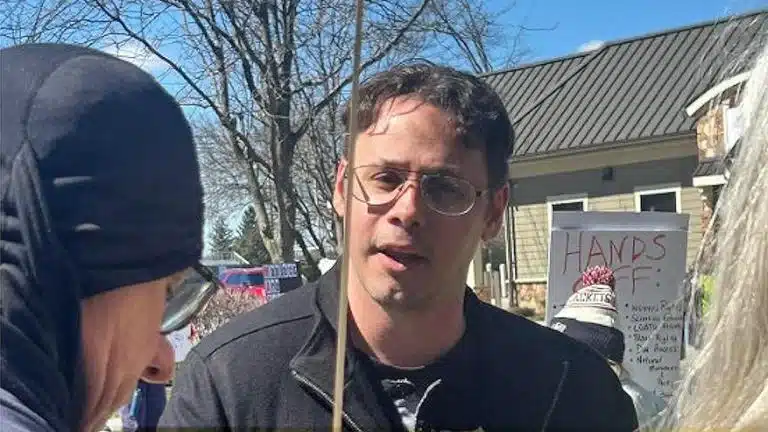
The Supreme Court on Thursday declined to allow a self-described “progressive” candidate onto Ohio’s Republican primary ballot after state officials determined he falsely claimed Republican affiliation in an effort to run in a heavily GOP district. His one purpose? Infiltration.
Samuel Ronan, a former Democratic candidate for state and national office, sought to challenge Republican Rep. Mike Carey in Ohio’s 15th Congressional District by filing to run as a Republican. As part of that filing, Ronan signed a declaration of candidacy — under penalty of election falsification — affirming he was a member of the Republican Party.
Fox News reports that according to documents filed in U.S. District Court, Ronan had publicly stated that his campaign was part of a broader strategy to place Democrats on Republican ballots in “deep red districts” to “get a foot in the door.”
Republican voter Mark Schare challenged Ronan’s candidacy before the Franklin County Board of Elections, submitting social media posts and interview excerpts as evidence that Ronan intended to “trick” Republican voters.
After the board deadlocked along party lines, Ohio Secretary of State Frank LaRose removed Ronan from the ballot, arguing the matter implicated “the integrity of the electoral process.” LaRose sharply criticized what court filings described as Ronan’s effort to infiltrate the Republican Party.
Ronan maintained he had not lied about his political affiliation, pointing to examples of politicians who had changed party allegiance over time, including former President Ronald Reagan, President Donald Trump, and “hundreds of others,” according to a report from Courthouse News Service.
He then filed suit in federal court, alleging the state violated his First Amendment rights by using his own political speech as grounds for disqualification.
Chief U.S. District Judge Sarah D. Morrison rejected that argument, ruling that constitutional free speech protections do not shield a candidate who files a false declaration of candidacy.
“It cannot be the case that a State must allow a candidate on a partisan ballot even if he lied about his party affiliation simply because the First Amendment is implicated,” Morrison wrote in her opinion.
Morrison further noted that while Ohio law permits candidates to change political parties, election officials are not obligated to disregard public statements that conflict with a sworn declaration.
The court concluded that Ohio has a “substantial interest” in preventing candidates from falsely certifying party membership in order to gain ballot access.
Following his defeat in lower court, Ronan petitioned the Supreme Court on Monday for emergency intervention before early voting began. Justice Brett Kavanaugh, who was appointed by Trump, referred the request to the full court, which denied the application without explanation, according to Courthouse News Service, adds Fox News in its report.